Drought Resilience Considerations
For Those Forgotten, Pretty, Hilly, Rocky, Rural, Wood Lots
RE: Neglect of Fire Hazards And Possible Mitigation
By Bo Atkinson For Montville Resilience Meeting
Indifference to conservation harms resilience to climate extremes.
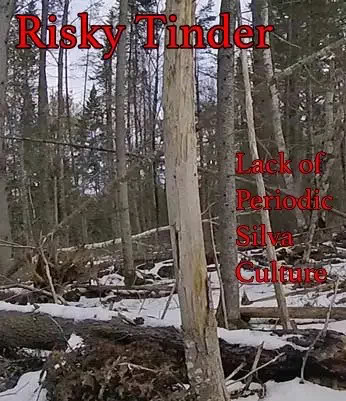
Homes near to woods can improve resiliency by minimizing fire risks due to better-managed woodlands. In case of very dry and windy conditions, safety is best assured if diseased trees are removed in order to avoid fallen wood clutter which can feed forest fires.
Balanced conservation must count losses of tree health as lost wealth for land owners who deserve to know of this. Silvi or silva culture provides a balance . Find useful information about Silviculture and Definitions
Decades of ample growth can choke the never-pruned , younger plots of overgrowth, and these are more likely to fuel forest firee and worsen fire risks.
Risk Assessment:
Loss of multiple homes to large wild fires would devastate and displace human lives, and simultaneous burnouts could reduce taxation revenues for the municipality.
A Wildfire Resiliency Check-list:
Mitigating this neglected hazard is possible with private attention and labor.
Tailored operational methods could be reviewed and discussed including municipal tree-waste-recycling to mitigate fire risks and at the same time enhance environmental harmony.
Examples of gentler, micro-scale equipment and methodologies could be reviewed and discussed with locally interested people or neighbors, some of whom might be glad to remove undesirable or fallen trees.
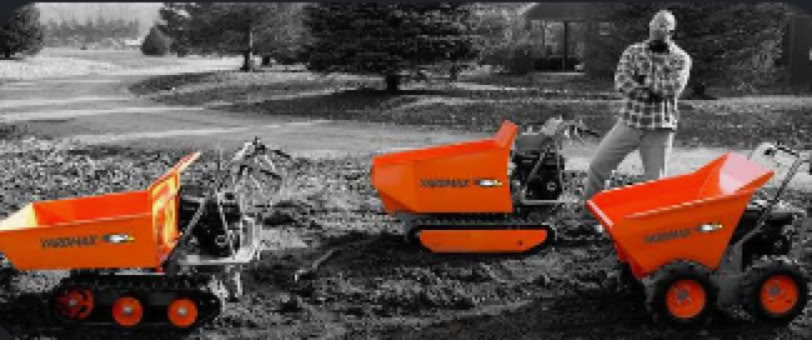
Threaded micro-machines gently leave lawns and fields smooth without rutting the soil as wheeled vehicles do, during wet seasons. Wet seasons are an important time for prunning. Only since 2023 have micro-sized treaded wheelbarrows been sold in Maine.
Land owners could submit photos of specific concerns on their wooded property. Preliminary, unofficial, specifically-local-photos and comments could be shared and evaluated by trusted community members, to respect privacy, and to share safety concerns and recommendations.
Promotional Concept: Some of the micro-scale treaded wheelbarrows include a minimalist front end loader, (good for chips and wood duff). Check out Youtube for many vids ontracks + wheelbarrow. For best price, maybe go to page 5 or 6 of “sort by price: Low to High”…Imported micro-machines offer the most options.
Conservational-fire-pruning is possible on scenic land without harm to nature, and it can potentially beautifies wooded land. Wood lot wreckage builds up in cases where new growth was never nursed nor pruned.
Promotional Concept: Processing and marketing to mitigate accumulated tree wreckage into chips, fire wood, wood fibre and wood-based mulching products, all of which improves rural opportunities while protecting valuations against severe drought damages of the future.
Promotional Concept: Diseased wood buildups are unprofitable for large mechanized operators, and decades of resultant, diseased, wooded patches have created incentive for micro equipment operators to fill this service gap with ecological-bravery, specifically addressing diseased-wood buildups and small scale, gentler operations. Prove that small is beautiful.
Super Conservational Mulching Of Twigs
Chipper-machines are expensive to own and operate, but there is a very low cost method which beautifully mulches baranches and dead wood, but which take years to ‘age’. A shallow, pitched, flat trench which drains seasonal-surface-run-off provides good containment and composting for deadwood and branch trimmings:
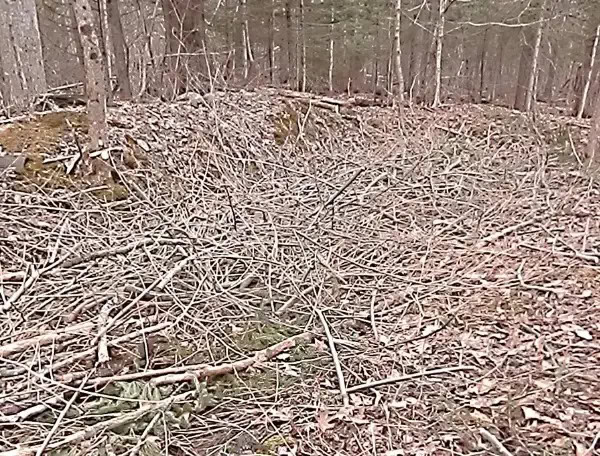
Photo Above: The bank to left was formed with a tractor over five decades earlier. Many branches were piled in shallow ditch and the newest layed pile of branches were successively chain-sawed into short bits:
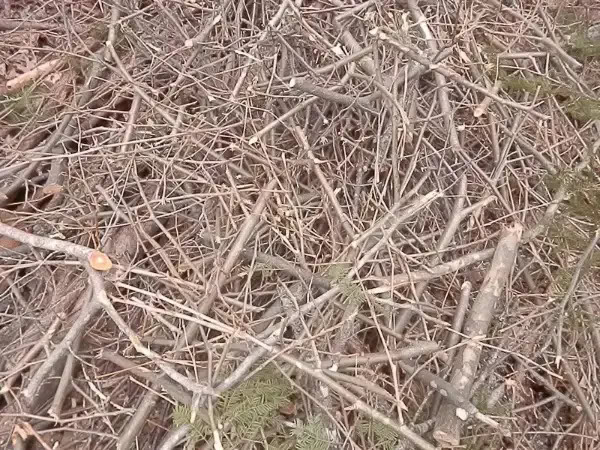
The result compacts the branch pile and amazingly processes large amounts of branch wastes in a small ditch or swale, with far less energy used up. Over the years the twigs compost into useful mulch, at lower operational costs and with negligible investment.
Conservational mitigation improves public holdings and safety. A safer future of integrated wood lot pruning with marketing is the pioneering goal.
Based on 50+ Years of Observations In Montville Maine
Bo Atkinson, Montville, Maine
================
Maine law partly addresses the matter:
Title 12: CONSERVATION
Part 11: FORESTRY
Chapter 807: FOREST FIRE CONTROL
Subchapter 4: REGULATION OF OPEN BURNING
Article 3: DISPOSAL OF SLASH
“...must be removed or limbed and placed on the ground surface so that the pieces are separated and not piled one piece over another.”
================
Example from another State:
https://www.nfpa.org/education-and-research/wildfire/firewise-usa/become-a-FirewiseUSA - NFPA
firewise-usa-site/frequently-asked-questions Quotes:
“What are the most important things to do to protect my home?
"Most homes that burn during a wildfire are ignited by embers or firebrands landing on the roof, in gutters, on or under decks and porches, or in vents or other openings in the home.”